

4 min read
There are cities that preserve themselves. And there is Paris.
Paris does something different. It reinvents, quietly and relentlessly, without ever asking permission. It is a city that does not simply hold its history, it keeps adding to it. And every so often, it does something that stops you entirely.
This is one of those moments.
The Work
From mid-June to early/mid-July, artist JR transforms the Pont Neuf, Paris’ oldest bridge, into something it has never been before: a cave. La Caverne du Pont Neuf is a monumental inflatable structure, 120 metres long and up to 18 metres high, designed as a life-sized trompe-l’œil of raw limestone. The idea came from the quarries beneath the city, the same ones from which the bridge’s stones were extracted four centuries ago. JR digs, symbolically, beneath the surface of Paris to reveal what it is actually made of.
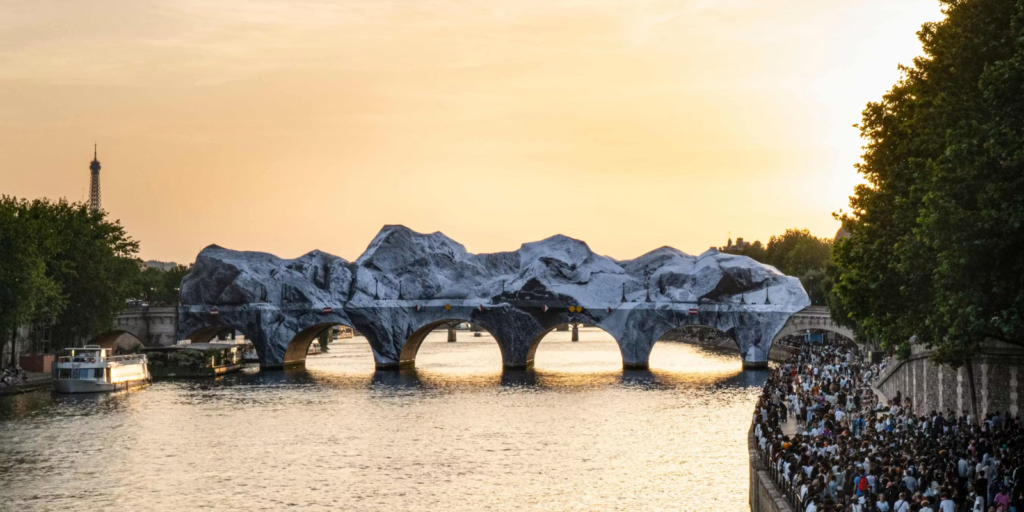
Walking through it is a full sensory experience. The interior tunnel has been described by JR himself as “a step into the unknown.” Thomas Bangalter (one half of Daft Punk) conceived the sonic environment: not a soundtrack in any traditional sense, but an electroacoustic texture designed to make the space feel geological, resonant, alive. An augmented reality layer, developed with Snap, adds a further dimension for those who want to go deeper.
The installation is free to visit, open around the clock, and visible from the Seine, from the surrounding quays, and, on a clear day, from the top of the Eiffel Tower.
The Homage
To understand La Caverne, it helps to understand what it honours.
In 1985, Christo and Jeanne-Claude wrapped the Pont Neuf in over 41,000 square metres of fabric, secured with kilometres of rope and tons of steel cable. It took a decade of negotiations to make it happen. It stood for two weeks. Three million people came to see it.
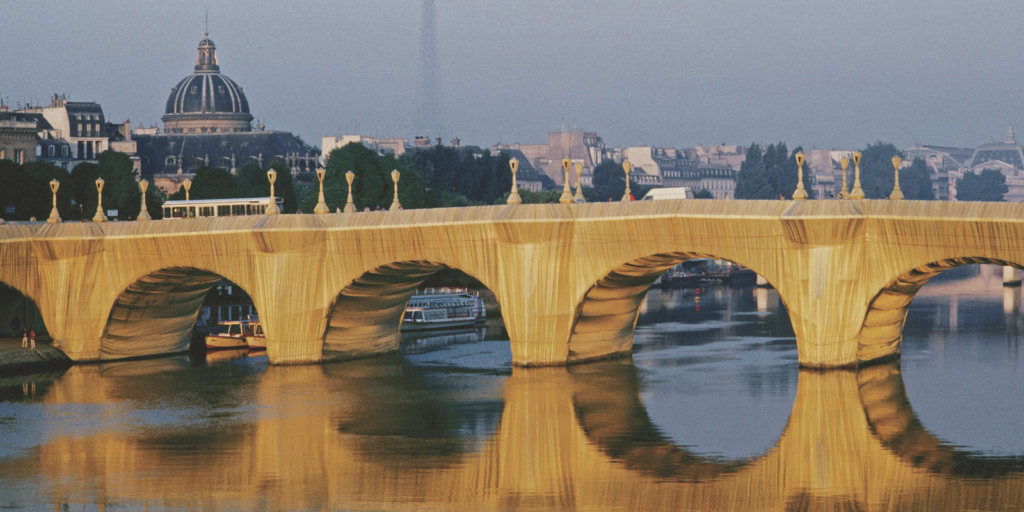
Forty years on, that gesture remains one of the most radical things ever done to a Parisian monument.JR does not recreate it. He responds to it. Where Christo revealed the bridge by wrapping it, JR makes it disappear into geological fiction. It is a conversation across time, and the fact that Bangalter, who counts The Pont Neuf Wrappedamong his most vivid childhood memories, is part of it only deepens that sense of continuity.
A City That Never Stops
There is a temptation to treat Paris as a finished thing. A collection of monuments. A postcard. Paris has never cooperated with that idea.
The Eiffel Tower was supposed to be dismantled. It wasn’t. Certain works that seemed provisional became permanent. Others, entirely temporary, left impressions that lasted a lifetime. The Paris 2024 Olympics reminded the world of this again: some moments, even fleeting ones, become part of how a city is remembered.
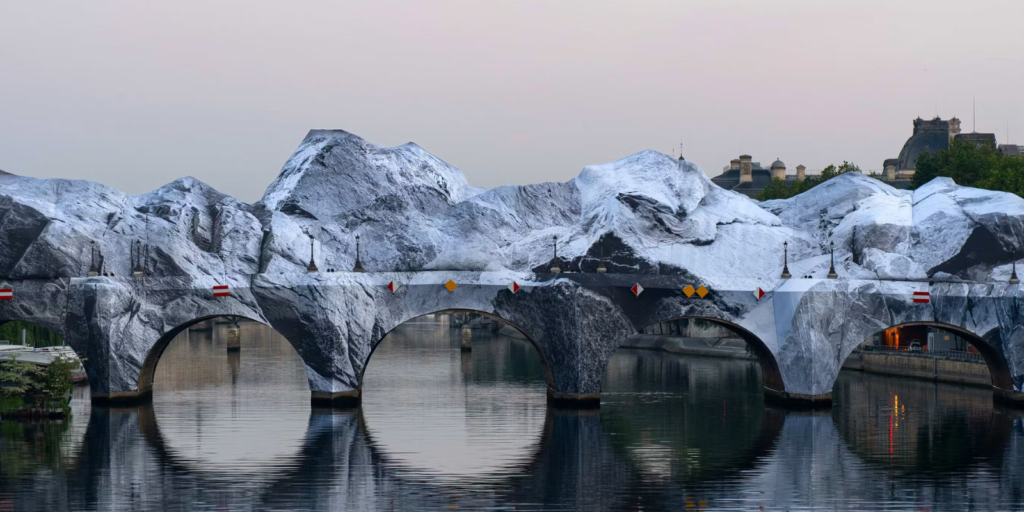
La Caverne du Pont Neuf sits in exactly that space. It arrives as a tribute, opens as a spectacle, and may well linger as one of those defining images of Paris in the summer of 2026. You never quite know, with these things, whether you are watching a footnote or a landmark in the making.
What is certain is that it will be gone by the end of June.
What This Means for Your Clients
For those who travel to experience culture at its most alive, this is precisely the kind of moment that cannot be rescheduled.
There is the client who comes to Paris for its icons, who wants to stand before the things that define French civilisation. For them, La Caverne offers something rarer: an icon in formation. Not yet enshrined, not yet reproduced on every postcard, but happening now.
There is the client drawn to debt, who wants to understand not just what a place looks like, but what it is made of. The concept speaks directly to them.
And there is the client who simply wants to be somewhere extraordinary at an extraordinary moment.
For all three, Paris in June 2026 will be exactly that. At the Galerie Perrotin, JR will also present Les Esquisses de la Caverne, a free exhibition of preparatory drawings and research running from June 5 to July 25, for those who want to understand how something like this is imagined into existence.
At Découvertes DMC France, we build itineraries around exactly this kind of moment. Whether your clients are spending a few days in Paris or travelling more broadly through France, we can help you place this experience where it belongs, not as an add-on, but as one of the memories that defines the trip.
Whether your clients are spending time in northern France, Normandy, the Loire region, or the Dordogne, we are happy to help you build something around these places that feels cohesive, well-timed, and genuinely tailored.
Send your requests to ; we would love to help you build something around it.